local law 55
New York City has a specific law about mold in rental apartments. Local Law 55 of 2018 sets out what building owners must do about mold and pests, and the city’s Health Department and HPD explain how it works alongside the state’s mold licensing rules. This article sets out those duties in plain words, with the lines that decide who must do what.
NYC Water Damage Repair is an independent referral service, not a restoration or mold remediation company, and nothing here is legal advice. When you send the form, your details go to an independent local restoration provider serving New York City, who can contact you, inspect and quote any work directly. You decide whether to hire them.
What Local Law 55 says
HPD summarizes it this way: Local Law 55 of 2018 requires that owners of buildings with three or more apartments keep their tenants’ apartments free of mold and pests, and this includes safely fixing the conditions that cause these problems. Owners must inspect units every year and respond to complaints from tenants or HPD. The Health Department adds the same duty applies in buildings of any size where a tenant has been diagnosed with moderate or severe persistent asthma.
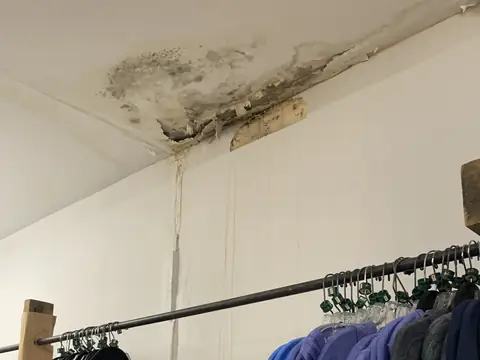
The words that matter most for water damage are the conditions that cause these problems. Mold in an apartment is nearly always fed by moisture, and the Health Department says the owner’s duty includes safely repairing underlying problems like water leaks. Wiping the wall is not enough if the pipe behind it is still dripping.

The 10 square foot line
| Size of the mold | Building | What applies |
|---|---|---|
| 10 square feet or less | Any | The Health Department’s small-area steps: soap and water on hard surfaces, waterproof gloves, children and pets kept away, dry completely |
| More than 10 square feet | 10 or more apartments, or 25,000 or more square feet of non-residential space | New York State Department of Labor licensed mold assessment and remediation workers, with filings on DEP’s Mold Abatement website |
| More than 10 square feet | 10 or more units | HPD: the assessor and remediator must be completely independent of each other |
State law, as the Health Department puts it, prohibits the same licensed worker from carrying out both the assessment and the remediation on a property, to protect against fraud. HPD lists the rules behind this as the city’s Administrative Code section 24-154, New York State Labor Law Article 32 and Local Law 61 of 2018.
What to do if you live in an apartment with mold
- Look for the water. A leak from upstairs, a bathroom without a working fan, a radiator valve, a window that sweats. Note it.
- Notify your landlord, in writing if you can, with photos and the date. HPD tells tenants who observe a leak or signs of mold to notify the landlord.
- Clean a small patch safely if you choose to: the Health Department’s steps above. EPA says bleach and other biocides are not recommended as a routine practice during mold cleanup.
- If it comes back quickly, the Health Department says there may be an underlying problem such as a water leak. Report it again.
- If the landlord does not fix it, or the repair is not being done safely, HPD says to file a complaint online or call 311.
Keep the record
Dated photos, copies of what you sent the landlord, and any 311 complaint number. If the problem goes on, that record is what matters.
What owners should do
For owners and managing agents, the order is the same as any sound mold job: find and fix the water first, then deal with the mold at the right scale. EPA’s guidance is to dry water-damaged areas within 24 to 48 hours to prevent mold growth, which is the simplest way to stay out of the larger rules. For anything over 10 square feet in a building of 10 or more apartments, plan for a licensed assessor and a separate licensed remediator from the start. The page about mold remediation in NYC sets out how such a job runs.

Co-ops and condos
Local Law 55 is written around owners and their tenants. In a co-op or condo where you own your unit, who handles mold inside it depends on where the water came from and on the building’s own documents. Ask the managing agent, and if a leak from a building pipe or another unit caused it, get the source in writing. A leak from upstairs has its own article: water damage from the upstairs neighbor.
Questions people ask
Which buildings does Local Law 55 cover?
Buildings with three or more apartments, according to HPD. The Health Department adds buildings of any size where a tenant has moderate or severe persistent asthma.
Can I sue my landlord for mold in NYC?
This site cannot give legal advice. HPD’s route for tenants is to notify the landlord and, if it is not fixed, file a complaint online or call 311. For legal questions, ask a lawyer.
Does my landlord have to inspect for mold?
HPD says owners covered by Local Law 55 must inspect units every year and respond to tenant or HPD complaints.
Water coming in?
Tell us where it is coming from and a local provider can contact you.
NYC Water Damage RepairFive boroughs